
Know Your Rights: Supreme Court & NHRC Guidelines on Arrest in India
An arrest significantly restricts a person’s liberty. To prevent the abuse of police power and safeguard fundamental human rights, both the Supreme Court of India and the National Human Rights Commission (NHRC) have laid down strict, legally binding guidelines.
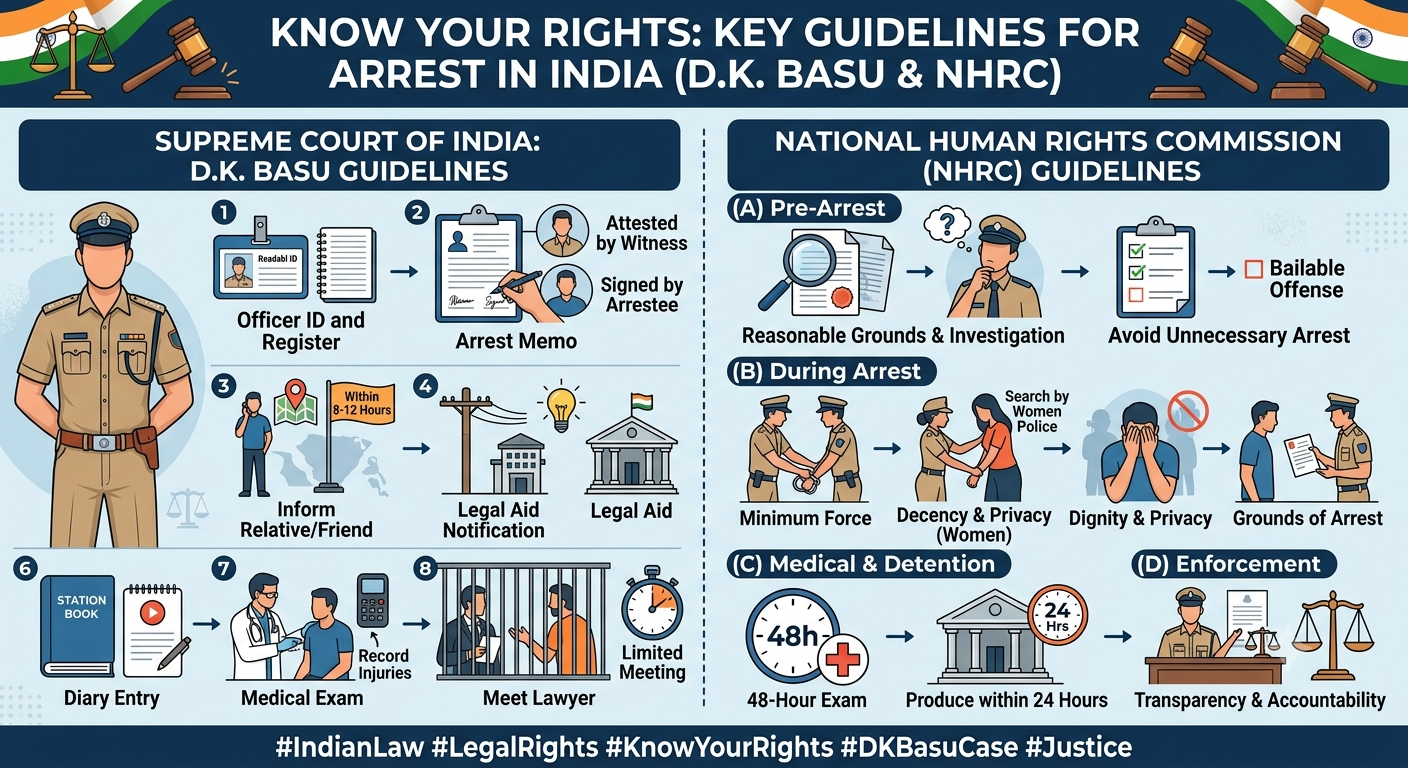
Whether you are a law student, a citizen, or a human rights advocate, understanding these rules is essential. Here is a simplified, systematic breakdown of your rights and police duties before, during, and after an arrest.
1. The Landmark D.K. Basu Guidelines (Supreme Court)
In the case of D.K. Basu Vs State of West Bengal, the Supreme Court established 11 core mandates that police personnel must follow during arrest and interrogation:
🪪 Identification & Records
Clear Identification: All police personnel conducting arrests or interrogations must wear accurate, visible, and clear name tags showing their designation.
Register Entries: The details of all personnel handling the interrogation must be recorded in a dedicated police register.
📝 The Arrest Memo
Mandatory Memo: The arresting officer must prepare an Arrest Memo at the time of the arrest.
Witness Signatures: The memo must be attested by at least one witness (either a family member of the arrestee or a respectable local citizen).
Counter-Signature: The arrestee must counter-sign the memo, which must clearly state the exact date and time of the arrest.
📞 Right to Inform Loved Ones
The 8–12 Hour Rule: The arrestee has the right to have a friend, relative, or well-wisher informed of their arrest and location as soon as possible.
Out-of-Town Notification: If the next of kin lives outside the district or town, they must be notified telegraphically through the District Legal Aids Organization and the local police station within 8 to 12 hours of the arrest.
Right Awareness: The police must inform the arrestee of this specific right immediately upon detention.
🩺 Medical Examinations & Health
Inspection Memo: At the time of arrest, the arrestee can request a body examination to record any existing major or minor injuries. Both the police and the arrestee must sign this "Inspection Memo," and a copy must be given to the arrestee.
48-Hour Routine Checks: During custody, the arrestee must undergo a medical examination every 48 hours by an approved doctor from the State/UT Health Services panel.
⚖️ Legal Help & Transparency
Access to a Lawyer: The arrestee is permitted to meet their lawyer during interrogation (though not throughout the entire interrogation).
Magistrate Records: Copies of all documents, including the arrest memo, must be sent to the local Magistrate for official records.
Police Control Rooms (PCR): A PCR must be established at all District and State headquarters. Information regarding the arrest and location of custody must be communicated to the PCR within 12 hours of the arrest and displayed prominently on a public notice board.
2. NHRC Guidelines: Pre-Arrest Checklist
The NHRC builds upon the Supreme Court's rulings, emphasizing that the power to arrest is not a license to abuse authority.
When is an Arrest Justified?
An arrest without a warrant (Joginder Kumar case, 1994) cannot be made casually. It is only justified under specific circumstances:
Grave Offences: The case involves heinous crimes like murder, dacoity, robbery, or rape, and the suspect is a flight risk.
Violent Behavior: The suspect is violent or likely to commit further crimes.
Tampering: The suspect is likely to destroy evidence, threaten witnesses, or tip off accomplices.
Habitual Offenders: The suspect is a repeat offender likely to commit similar crimes.
Rules to Avoid Unnecessary Arrests
Notice to Attend: Except for heinous crimes, police should issue a formal notice to attend the police station rather than making an immediate arrest.
Bailable Offences: Arrests should be avoided in bailable offenses unless there is a severe risk of the suspect absconding.
NHRC Medical & Injury Documentation
Injury Register: Immediately upon arrest, any existing injuries must be detailed in the arrest register, signed by both the officer and the arrestee. A copy/certificate of this must be given to the arrestee upon release.
Prompt Medical Aid: If an arrestee requests medical aid—or if the police see they clearly need it—it must be arranged immediately.
Female Medical Care: A female arrestee requesting medical help must only be examined by a female registered medical practitioner.
3. NHRC Guidelines: Post-Arrest & Interrogation
The 24-Hour Rule: The arrested person must be produced before the nearest judicial Magistrate within 24 hours of the arrest (excluding travel time).
Humanitarian Interrogation: Interrogations must be conducted at a clearly identified, legally notified government venue. Relatives must know this location.
No Torture: Interrogation methods must respect the right to life and dignity. Torture and degrading treatment are strictly forbidden.
4. Accountability: How the Guidelines are Enforced
To ensure these guidelines do not just stay on paper, the NHRC mandates the following enforcement system:
Publicity & Display: Guidelines must be translated into local languages, given to every officer in a handbook, and displayed prominently on notice boards in every police station.
Complaint Redressal Mechanism: The police must set up an independent complaint system to handle violations of these guidelines. Its contact details must be clearly displayed on station notice boards.
Strict Punishment: Errant police officers who violate these rules face not just departmental inquiries, but criminal prosecution and contempt of court charges.
-GET IN TOUCH
Submit an inquiry
For information regarding legal processes, initiate an inquiry and one of our team members will respond promptly.
By submitting this inquiry, you confirm that you are seeking information of your own accord and that no solicitation has taken place as per Rule 36 of the Bar Council of India.

Request Information on Legal Procedures
Info@Legumowls.com, Legumowls@gmail.com